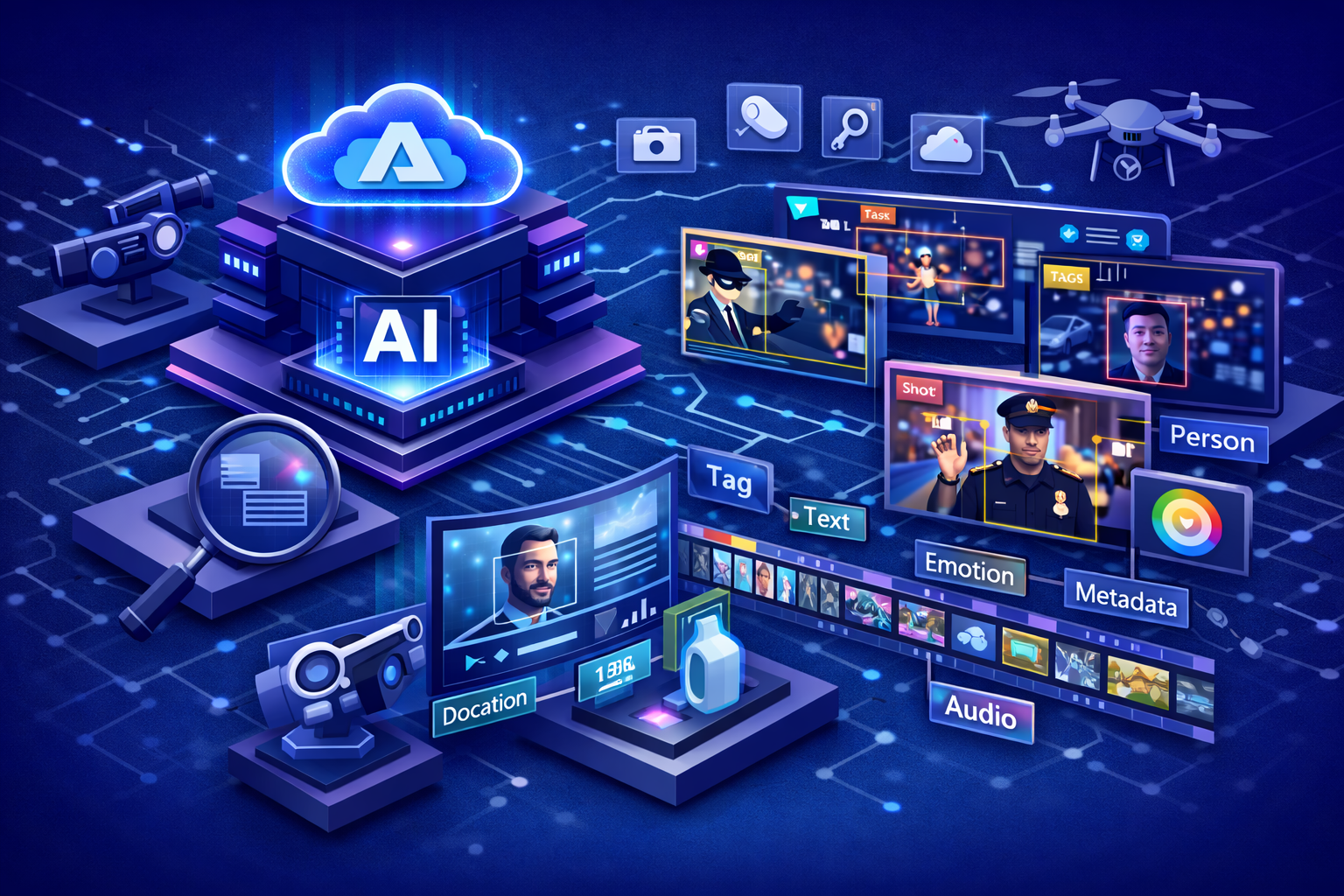
Understanding Azure AI Video Indexer
Azure AI Video Indexer is Microsoft Azure’s video and audio intelligence service for extracting meaningful insights from stored media and, in selected architectures, live video streams. It helps organizations analyze content that would otherwise require time-consuming human review by applying a combination of speech, vision, language, and generative AI capabilities to media assets. Instead of treating video as passive content, Azure AI Video Indexer allows businesses to treat it as a rich source of searchable knowledge and operational insight.
This is increasingly important because video and audio are now central to many industries and enterprise functions. Training sessions, meetings, interviews, customer service recordings, security footage, marketing content, news archives, product demonstrations, compliance recordings, and operational video streams all contain valuable information. Azure AI Video Indexer helps organizations unlock that value by turning media into structured outputs that can support search, analytics, automation, and intelligent experiences.
Why Video Intelligence Matters in Modern Organizations
Video is one of the richest content formats in the enterprise, but it is also one of the hardest to use at scale. A single video can contain spoken language, on-screen text, visual events, contextual changes, and multiple segments that matter for different business reasons. Without AI, much of that information remains difficult to discover, classify, or operationalize. Teams often need to watch hours of content manually just to find a few important moments.
Azure AI Video Indexer matters because it reduces that friction. It helps organizations make video content discoverable, searchable, and far more useful across digital workflows. Instead of searching only by filename or metadata entered by hand, businesses can search by spoken words, visual cues, detected scenes, extracted text, and inferred topics. This transforms media from static storage into an active source of business intelligence.
Core Capabilities of Azure AI Video Indexer
Azure AI Video Indexer includes a broad set of capabilities that help organizations understand both the audio and visual dimensions of media content.
-Speech Transcription: Converts spoken audio into text so video and audio content become searchable, analyzable, and easier to reuse across workflows.
-Translation and Subtitles: Supports multilingual accessibility and broader reach by translating spoken content and enabling subtitle-oriented use cases.
-Scene and Shot Detection: Breaks videos into meaningful segments, making long-form content easier to navigate and understand.
-Visual Analysis: Detects important visual elements such as objects, key frames, and other scene-related insights that help describe what happens in the video.
-Optical Character Recognition: Extracts visible on-screen text from video frames so titles, signs, overlays, and embedded text become part of the searchable media record.
-Summarization: Generates concise summaries that help users understand important moments and key themes without watching the full content.
-Timeline-Based Insights: Organizes extracted signals into a shared timeline so users can see when events, speech, text, and visual cues appear throughout the media.
From Raw Media to Structured Intelligence
The real value of Azure AI Video Indexer is not just that it can analyze media, but that it can convert unstructured video and audio into structured intelligence. A long recording becomes a timeline of searchable moments. A training video becomes indexed knowledge. A customer call recording becomes text, topics, and operational insight. A media archive becomes easier to classify, retrieve, and reuse.
This changes how organizations work with media. Instead of relying on manual tagging or watching content from start to finish, teams can jump directly to relevant segments, identify patterns across large collections, and connect video-derived insight to business processes. That is where Video Indexer becomes more than a media analysis tool. It becomes part of a broader intelligent content strategy.
The Power of a Shared Insight Timeline
One of the most practical strengths of Azure AI Video Indexer is the way it brings multiple insights together into a common timeline. Speech, text, scenes, objects, and other media signals are not treated as isolated outputs. They are organized around when they occur in the content. This allows users and systems to understand the full context of a specific moment rather than looking at separate analysis results independently.
In enterprise scenarios, this is highly valuable because content meaning often depends on combinations of signals. A spoken phrase may matter only when paired with a visual scene change. A product mention may become more useful when connected to a detected frame or visible title. Timeline-based insight helps transform fragmented media analysis into something operationally coherent and easier to use.
Key Business Use Cases
Media Asset Management
Organizations with large media libraries can use Azure AI Video Indexer to improve content discoverability, categorization, and reuse. Marketing teams, broadcasters, training departments, and digital media organizations can index video collections so users can find specific segments, themes, spoken phrases, or visual moments much faster.
Content Search and Knowledge Discovery
Enterprises often store video recordings that contain valuable knowledge but are difficult to access efficiently. Azure AI Video Indexer can help transform those recordings into searchable knowledge assets, allowing employees to locate key explanations, spoken decisions, demonstrations, or insights without having to review the entire media file manually.
Compliance and Operational Review
In industries where recordings must be reviewed for policy, quality, safety, or compliance reasons, Azure AI Video Indexer can reduce manual effort by helping teams identify relevant segments more quickly. Instead of reviewing every minute in full, teams can use indexed insights to focus on the portions of content most likely to require attention.
Customer Experience and Contact Analysis
Video and audio interactions with customers can contain valuable information about service quality, recurring issues, and communication effectiveness. Azure AI Video Indexer can help organizations extract and organize this information so it supports quality review, performance improvement, and better service design.
Live and Edge-Oriented Monitoring Scenarios
In selected Azure Arc-enabled deployments, Azure AI Video Indexer can also support real-time analysis on live video streams at the edge. This makes it relevant for scenarios such as site monitoring, safety-oriented detections, operational oversight, and environments where data locality, latency, or on-premises processing requirements are important.
How Azure AI Video Indexer Fits into the Azure AI Ecosystem
Azure AI Video Indexer becomes more powerful when it is used as part of a broader Azure architecture. In many enterprise solutions, it serves as the media understanding layer that prepares content for search, retrieval, analytics, automation, and AI-powered applications.
-Azure AI Search: Uses indexed transcripts, extracted text, summaries, and metadata to improve retrieval across video and audio repositories.
-Azure OpenAI Service: Can use video-derived transcripts and summaries as grounding context for question answering, summarization, and generative AI workflows.
-Azure AI Foundry: Provides a broader platform for building, evaluating, and governing intelligent applications that depend on media understanding.
-Azure AI Speech: Complements video indexing with broader speech capabilities such as voice interfaces, additional speech workflows, and transcription-driven scenarios.
-Azure AI Vision: Adds broader image analysis capabilities in scenarios where frame-level visual intelligence must be extended further.
-Azure Storage and Data Platforms: Support the storage, indexing, processing, and lifecycle management of media assets and derived outputs.
-Azure Monitor, Key Vault, and Microsoft Entra: Strengthen security, access control, secrets management, and observability across production deployments.
Azure AI Video Indexer in Intelligent Media Workflows
Azure AI Video Indexer is especially useful in workflows where media must be processed before humans or AI systems can use it effectively. A media file might need to be transcribed, segmented, summarized, and enriched before it becomes useful to a search system, knowledge assistant, compliance reviewer, or downstream analytics platform. Video Indexer supports this transformation by creating media outputs that are far easier to work with than the raw file alone.
This means organizations can incorporate video more naturally into broader intelligent systems. Once indexed, media can support enterprise search, retrieval-augmented applications, agent-driven workflows, content recommendation, archive management, and operational review processes. The more video becomes a source of institutional knowledge, the more important this kind of transformation becomes.
Architecture Considerations for Production Deployments
A production-ready Azure AI Video Indexer solution usually involves more than uploading a file for analysis. Teams should think carefully about ingestion patterns, storage design, indexing workflows, metadata strategy, language coverage, access control, output validation, and downstream integration requirements. These decisions affect not only technical performance, but also business usefulness and operational trust.
In many enterprise architectures, media assets are stored in Azure repositories, processed through Azure AI Video Indexer, enriched with transcripts and metadata, and then connected to search systems, content platforms, dashboards, or AI-driven applications. In live or edge-oriented scenarios, video streams may also be analyzed closer to the source to support faster detection and lower-latency decision-making. The best architecture depends on whether the main goal is archive intelligence, real-time awareness, compliance review, or AI-powered knowledge access.
Best Practices for Azure AI Video Indexer Adoption
-Start with a High-Value Media Scenario: Focus on use cases where large volumes of video or audio create search, review, compliance, or discovery challenges.
-Design for Searchability: Treat transcripts, summaries, segments, and extracted text as business assets that should support retrieval and reuse.
-Use Timeline Insights Strategically: Take advantage of time-based indexing to connect events, speech, and visual cues in a more meaningful way.
-Integrate with Broader Workflows: Connect indexed outputs to search, AI orchestration, analytics, or operational systems instead of treating indexing as an isolated task.
-Secure Media and Derived Outputs: Apply appropriate governance to recordings, transcripts, summaries, and metadata, especially when content is sensitive or regulated.
-Plan for Scale Early: Consider ingestion volume, processing patterns, storage lifecycle, cost, and multilingual requirements from the beginning.
Common Challenges Organizations Should Address
Although Azure AI Video Indexer can significantly improve how organizations use media, successful adoption still depends on practical architecture and content readiness. Common challenges include variable audio quality, inconsistent source footage, multilingual content, specialized terminology, long processing pipelines, metadata design, and the complexity of integrating indexed insights into existing business systems.
Another challenge is assuming that indexing alone creates business value. In reality, the strongest results appear when indexed outputs are connected to real workflows such as discovery, compliance, support, analytics, search, or intelligent assistants. The service is powerful, but its greatest value comes when media intelligence becomes part of a broader operational design.
The Strategic Value of Video Intelligence
Azure AI Video Indexer delivers strategic value by helping organizations unlock one of their most underused information sources: media content. When businesses can extract meaning from every frame and every spoken moment, they improve how they search knowledge, govern content, automate review, understand operations, and build richer digital experiences. This creates a strong advantage in industries and functions where video and audio play a central role.
More broadly, the service helps organizations move toward a more intelligent content model. Instead of storing video as difficult-to-use media files, they can turn recordings into structured, discoverable assets that contribute to enterprise knowledge and decision support.
The Future of Media Intelligence in Azure
The future of Azure AI Video Indexer is closely connected to the broader evolution of multimodal AI, generative summarization, live operational awareness, and intelligent content systems. As organizations increasingly work across text, audio, images, and video in unified workflows, media understanding will become more central to enterprise AI architecture rather than a specialized capability used only by media teams.
Azure AI Video Indexer is well positioned for this future because it already combines transcription, visual analysis, summarization, and timeline-based insight in a way that makes media easier to search and operationalize. As enterprises continue building AI-powered knowledge systems, media intelligence will become even more important in how information is captured, understood, and used.
Conclusion
Azure AI Video Indexer is extracting intelligence from every frame by helping organizations analyze video and audio content through transcription, translation, visual analysis, segmentation, summarization, and timeline-based insights. It gives businesses a practical way to make media content more searchable, understandable, and useful across search, compliance, operations, and intelligent application scenarios. For organizations looking to unlock greater value from their media assets, Azure AI Video Indexer represents a powerful foundation for modern video intelligence in Microsoft Azure.